It works the case overnight, shows you how, and tells you when it was wrong.
Most AI in this category is a chat box pointed at your data. Narada picks the findings worth the most money and digs into them while the building is empty. It writes up the cause and drafts the fix. Then it commits to a dated claim, and a week later it grades itself on that claim in public.
It also cannot make a number up. Every figure comes from one of 33 verified tools, the same calculations behind the numbers on your screens. A guard reads the answer before you do and throws away any money figure no tool returned.
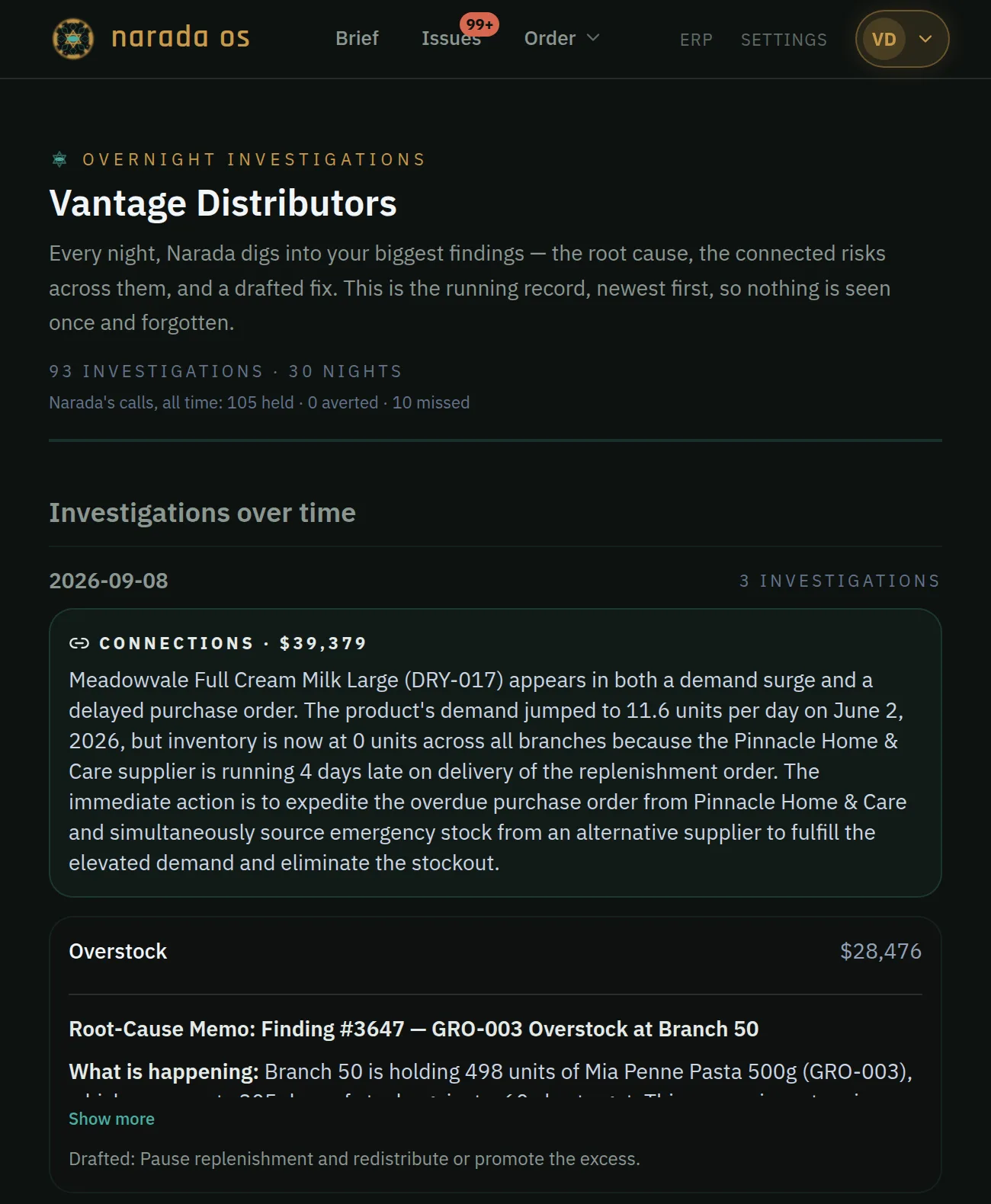
It picks its own cases, and nobody has to ask
This is the part that makes it a colleague rather than a search box. It runs on the findings the night shift raised, without a prompt from you.
It chooses by what the problem is worth
The night's open findings are ranked by the money at stake, and the top ones get investigated. Not the newest, not the loudest.
It digs, for longer than a live answer gets
A question you ask gets four rounds of tool calls before it must answer, because you are sitting there. An overnight investigation gets six, because nobody is waiting.
It writes the cause in plain English
What is happening, why, and which driver or formula produced the number. In your currency, with no statistical acronyms, and with every figure traceable to the tool that returned it.
It drafts the fix and stops
A draft purchase order, a drafted email, or a specific change to make. Stored, never sent. Narada proposes, you approve.
Then it reads its own memos together
Once the night's write-ups exist, it asks a second question. Do two or more of these trace back to the same upstream fact?
None of it is thrown away in the morning. Every night keeps its own page, newest first, so a problem is not seen once and forgotten. If you do not want to wait for tonight, you can set it on a finding on the spot.
Seven problems, one cause, one thing to do
When several of the night's findings share an upstream fact, Narada names the cause and the single action that addresses all of them.
You do not get the same problem five times wearing different hats. You get one line, and a total for what the group is worth together.
When nothing connects, it says nothing at all. Silence over noise is a rule here, not a mood.
The grouping behind it is structural, not guessed. Findings are tied to a supplier through your own product records. So "these seven are all that supplier's lead time" is a join, not the model's opinion.
You can read exactly how it got there
Every investigation stores its own trail: each tool it reached for, what came back, and the time it happened. Open the finding and it is there, step by step, under "How Narada worked it out".
Those are the product's own words for its steps, not a description of them.
The dead ends stay in too. One trail we pulled has a step reading "No SKU matching 2503, check the name or code". It carries on and finds the answer another way. A trail that only ever shows the lookups that worked is an edited one.
An answer you cannot audit is a rumour with good typography.
It commits to a call, then grades itself and keeps the losses
Each investigation ends with a claim that can be proved wrong. If this is not actioned by a stated date, the exposure it named still stands.
A week later Narada checks what happened. No model is involved in the check, and none is involved in writing the claim either. Both are templated arithmetic over a figure a tool already verified.
You actioned the finding before the date. The call did its job.
Nobody acted, and the exposure is still there at close to the value Narada named.
Nobody acted, and the exposure shrank anyway. Narada's claim was wrong, and that verdict stays on the scoreboard.
The running count sits at the top of the investigations page, where you cannot miss it. It is in the screenshot above. Software that scores itself and hides the losses is a brochure.
Photograph the order. It comes back as a purchase order.
Half of this trade still moves on a notebook page, a printed sheet, or a photo in a chat. Narada reads those.
Snap the handwritten page, the printed sheet or the screenshot. Narada reads the lines, matches them to your catalogue, and drops a draft purchase order into the app for you to finish. Items it cannot read are left out, not guessed.
Photograph the list your supplier sent. Narada reads the rows and diffs them against what you pay today. Then it tells you what the new prices do to your margin at your current run rate.
They are shown to you as unmatched, every time. Nothing is quietly rounded into a product that looked close enough.
The price-list read is analysis. It never writes a cost field, and it never writes to your ERP. The purchase order stays a draft until you send it.
Ask in your own words, and the arithmetic is done by tools
33 tools cover what you would actually ask. What is wrong today. Where the cash is. What to buy. One product, branch, supplier or customer. And drafting the fix.
A real question rarely maps to one lookup. It calls what it needs, reads the results, and calls again before it writes a word.
Under the answer sit the figures it used, each labelled with the screen it came from. That shortlist is picked from the wording of the answer itself, by a rule. No second model gets a chance to invent a source.
Point it at any figure on any screen. You get the formula behind it, the drivers that moved it, and the plain-English read. Nothing on that path is recomputed by the model or estimated.
"Which suppliers have been getting slower lately, and what is that costing us a year?"
It refused the premise. Asked which suppliers are getting slower, it said none are, then named and priced the real problem instead.
Often the useful answer is "don't"
A system that only ever agrees with you is not advising you. These are specific behaviours, not a disposition.
Before recommending any purchase it checks whether another branch is holding the stock. When a transfer covers the shortage it leads with that, and will not recommend the purchase without saying so first.
When a product it is about to reorder has an open decline or dead-stock finding, it flags the conflict. It will say the buy is questionable and that running the stock down may be the better call.
It withdraws a recommendation when a supplier minimum would bury you in cover. It will not restock a batch that cannot clear before it expires.
When the premise of what you asked is wrong, it says so and answers the question you should have asked.
What it is structurally unable to do
These are not settings, and they are not prompt wording. Each one throws work away rather than let a wrong thing reach you.
A guard, prose_is_money_safe, reads the answer before you do and discards any money figure no tool produced. Not flags it. Throws it away, and the investigation runs again.
When it searches your findings it gets a shortlist, and it is told in writing how many it did not see. It has to say "of the six I looked at" rather than count a category off that list and call it your total.
If a question needs a file you have not sent us, it says so and names the file that would answer it. A missing answer should read as honesty, not evasion.
Statistical acronyms are blocked, and so are raw internal field names and bare numeric ids. Your products are named the way you name them.
Every prompt carries your own currency. A dirham business is never quietly told a number in dollars.
When one finding covers dozens of items, the write-up is told so in as many words. The total never gets pinned on the one product it happened to look at.
Content out of your ERP is fenced off as data before the model reads it. A supplier cannot smuggle an instruction inside a product description.
Drafting and sending are separate steps, on separate endpoints, with your click in between. The connection is read-only by construction.
It keeps what you told it, and it forgets on request
It recalls your earlier questions, the calls you made on findings, and the preferences you have stated. That is what stops you re-explaining your business every Monday.
The step that searches your memory for the relevant one runs on our own server. It is a small open model, and that step makes no call to any AI provider.
Deleting a memory stops it affecting answers immediately, because the answer path only ever reads the live memory. The undo copy behind the history panel carries its own expiry date. "Forget this" does not quietly become a permanent second copy.
Memory is a nicety by design. If it fails it fails silently, and the answer still comes back grounded. Nothing you rely on is sitting on top of it.
Check it yourself
No signup. Your question, its data, its receipts.